
The Break Across the Flats
Return to Formation Cases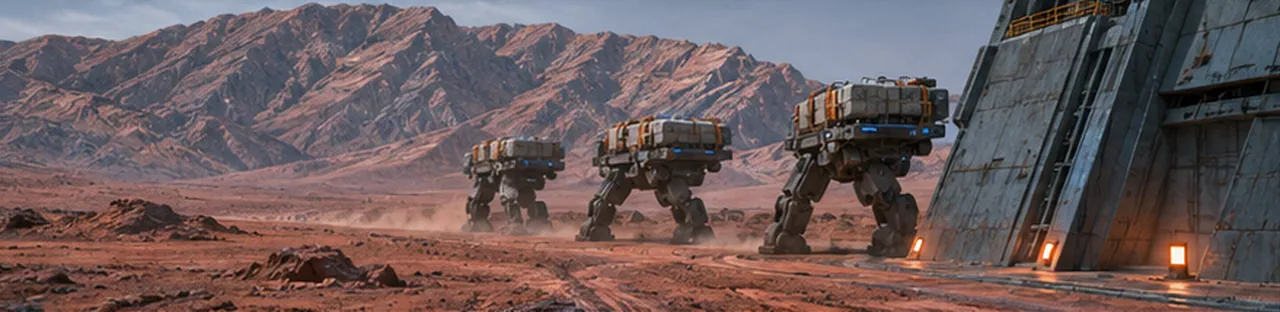
Plan around an irregular boundary
The larger formation begins next to a building and walks out onto open flats. A painted orange curve continues onto a stretch of firm ground. It leads around a dark ridge that sits a little away from the center of the route. Units at the inside have less distance to cover. Keep the outside group in view until it begins to reach the wide part beyond the first bend.
Measure the crossing with two different lanes
The outer route takes a longer curve beyond the boundary and runs close to a shallow depression. The inner route rounds it early and can leave the other units out of sight for a moment. The Inside of a Wide Turn compares two floor marks that stay visible from both lanes. Observe the gap between an outer chassis and one of those marks before deciding how soon the nearer group can move on.
Keep the first stop in reach
A clear area above the inside of the turn gives the group room to wait. The first stop has a direct view of the outer line and only a partial view of the exit. That keeps the next choice close to the part of the route that still matters. Once several units are visible beyond it, move the camera a little farther along and see where the next pale patch of ground begins.
Find where the lane ends before the door
The pair of tracks comes close together on the approach to two maintenance doors. A slow walker can fall on the other side of the curve if the wider group arrives early. Handoff at the Two Doors follows the change in the camera after the first door becomes active. The pilot can keep a view of the last moving unit before reading whether another group has already taken over the second route.
Leave room for a different formation
When a larger walker takes the outer track first, its position can hide one of the closer units. A pause at the earlier floor stripe gives the other machines time to reach the next view. With a smaller walker outside, the gap between the units can be easier to see but harder to judge from a distant camera. Both configurations can produce a readable finish by choosing a different time to wait.
Paint the environment as a shorter reference
The dry surface carries warm terracotta where the route leaves the blue hall. Lower parts of the machines keep a band of cool light as their legs move through a shadow. Straight tracks retain bright marks in the foreground, and the bend appears wider near the base of the ridge. The different colors should hold the shape of the route without turning the terrain into a diagram detached from the larger hall.
A development concept around pacing
The prototype now covers the change from two curves into a shared exit. It tests how a player keeps track of the units on both sides without treating the fastest move as the best route. Formation Cases displays one wide approach and two closer system studies. Future work could use the same group to cross another broad turn, after checking whether the first two floor marks still help people describe the earlier movement.